

Building Information Modelling Market Projected to Hit USD 31.54 Billion at a 13.0% CAGR by 2035
Building Information Modelling Market
Building Information Modelling Market supports digital construction through 3D modeling, collaboration, project efficiency, and lifecycle management.
ilding Information Modelling Market is transforming construction with collaborative 3D models that improve project planning, reduce errors, and enhance lifecycle management.”
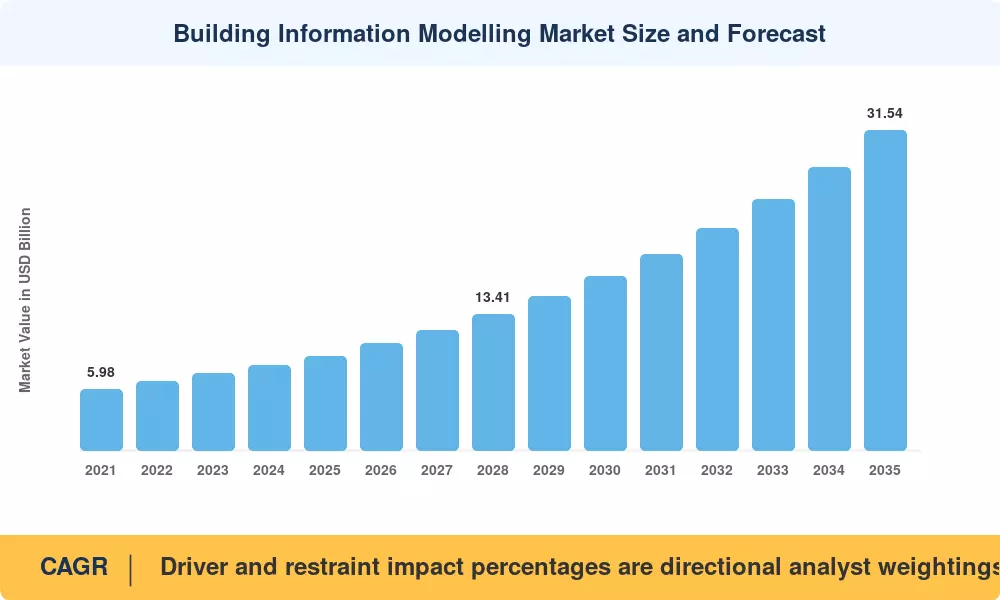
BERLIN, BERLIN, GERMANY, September 1, 2026 /EINPresswire.com/ -- The Building Information Modelling Market is undergoing rapid expansion as construction firms, architects, engineers, contractors, and asset owners are increasingly adopting digital workflows. According to Market Research Future, the market reached USD 9.24 billion in 2025 and is projected to rise from USD 10.50 billion in 2026 to USD 31.54 billion by 2035, representing a 13.0% CAGR during the forecast period.— Market Research Future
Building Information Modelling, commonly known as BIM, provides a structured digital representation of physical and functional building characteristics. Technology enables stakeholders to coordinate designs, visualize projects, estimate costs, manage schedules, identify clashes, and maintain asset information throughout the building lifecycle. This broader capability makes BIM an important component of construction digital transformation.
The Building Information Modeling Software Market, BIM Services Market, BIM technology, 3D building modeling, digital construction technology, cloud BIM, 4D BIM, 5D BIM, and BIM-based facility management are closely related surrounding the main market. These terms reflect the expanding ecosystem supporting digital design, project coordination, construction management, and lifecycle asset intelligence.
Get a Sample PDF of the Report at -
https://www.marketresearchfuture.com/sample_request/2044
Key Growth Drivers
One of the strongest factors supporting the Building Information Modelling Market is the growing emphasis on digital delivery requirements in public infrastructure and construction projects. Procurement frameworks increasingly require structured digital information, encouraging organizations to adopt BIM as part of their standard project processes rather than treating it as an optional technology. ISO 19650 has also strengthened the common framework for managing information across built assets.
Cloud adoption is another important growth catalyst. Cloud-based BIM platforms allow project participants to access shared models, drawings, schedules, documentation, and project information from different locations. This improves collaboration between architects, engineers, contractors, and owners while reducing dependence on traditional file-server environments. Market Research Future identifies cloud deployment as one of the fastest-growing areas of the market.
Increasing infrastructure investment is also creating significant opportunities for BIM providers. Large transportation, utility, healthcare, commercial, and public infrastructure projects require extensive coordination among multiple stakeholders. BIM helps teams identify design conflicts, improve construction sequencing, support quantity estimation, and create structured information that can remain useful after project completion.
Technology Integration and Innovation
The integration of artificial intelligence and automation is expected to reshape the Building Information Modelling Market. AI-assisted design can help generate alternative layouts, automate repetitive modeling activities, identify potential compliance issues, and support quantity extraction. These capabilities can reduce manual workloads while allowing design and engineering teams to evaluate more alternatives during early project stages.
BIM is also increasingly connected with digital twins, Internet of Things technologies, reality capture, laser scanning, and construction management platforms. Combining these technologies allows organizations to create richer digital representations of buildings and infrastructure. Real-time operational information can eventually be connected with BIM models, supporting predictive maintenance, energy optimization, and facility management.
Sustainability is becoming another major area of innovation. BIM platforms can incorporate material information, energy considerations, and embodied-carbon data into project models. This enables project teams to evaluate environmental performance earlier and make more informed decisions about materials, design alternatives, and building operations.
Market Segmentation
By Solution
The market is broadly divided into BIM software and BIM services. Software represents the largest portion of market revenue, supported by continued demand for design authoring, coordination, visualization, and project information management tools. Market Research Future reports that software accounted for 62.6% of market revenue in 2025.
BIM services include implementation, consulting, training, integration, customization, and outsourced coordination. As organizations adopt more sophisticated workflows, service providers help companies overcome skills shortages and manage the transition from conventional design processes to digital construction environments.
By Deployment
Deployment is generally categorized into on-premises and cloud-based solutions. On-premises systems continue to serve organizations requiring greater control over infrastructure and data management. However, cloud BIM is gaining momentum because it supports remote collaboration, centralized information management, and easier access for distributed project teams.
Cloud deployment is identified as a particularly fast-growing segment, with Market Research Future reporting a 16.9% CAGR through 2035. The shift toward subscription-based platforms also makes BIM technology more accessible to smaller architecture, engineering, and construction firms.
By Project Lifecycle
BIM supports activities across pre-construction, construction, and post-construction operations. Pre-construction remains an important stage because BIM enables design visualization, clash detection, estimation, planning, and coordination before physical work begins. Construction-stage applications include sequencing, field coordination, progress monitoring, quantity management, and constructability analysis. Post-construction applications are gaining momentum as owners recognize the value of structured digital asset information for facility management, maintenance, renovation, and future expansion.
By Application
Commercial buildings currently represent a major application area, supported by office developments, mixed-use projects, renovations, and complex building systems. BIM is particularly valuable for projects requiring coordination among architectural, structural, mechanical, electrical, and plumbing disciplines.
Infrastructure represents another high-growth opportunity. Transportation networks, utilities, bridges, railways, airports, and large public projects involve long asset lifecycles and multiple stakeholders. BIM can provide a common information environment that supports project planning and future asset management. Market Research Future identifies infrastructure applications as one of the fastest-growing application categories.
Buy Latest Edition of Market Study Now:
https://www.marketresearchfuture.com/checkout?currency=one_user-USD&report_id=2044
Regional Market Outlook
North America remains the leading regional market, accounting for approximately 34.8% of global revenue in 2025. The region benefits from established architecture and engineering capabilities, advanced construction technology adoption, and government and infrastructure requirements that encourage structured digital project delivery.
Asia-Pacific is expected to record the fastest growth, with a projected 13.6% CAGR through 2035. Rapid urbanization, infrastructure development, construction digitization, and government-led initiatives in countries such as China and India are creating significant opportunities for BIM software and service providers.
Europe also represents an important market because of its mature construction ecosystem and strong emphasis on standardized digital delivery. Mandates and sustainability objectives are encouraging organizations to integrate BIM into public procurement, design coordination, construction management, and asset operations.
Competitive Landscape
The Building Information Modelling Market includes major technology companies such as Autodesk, Trimble, Bentley Systems, Nemetschek Group, Dassault Systèmes, and Hexagon AB. These companies are developing integrated platforms that extend beyond conventional modeling into project collaboration, cost management, field operations, engineering analysis, digital twins, and asset lifecycle management.
Competition is increasingly focused on platform ecosystems rather than individual design tools. Vendors that can connect design data with construction scheduling, cost information, field capture, and facility management can create greater value for customers. Integration with AI, cloud platforms, digital twins, and sustainability analytics is expected to remain a major competitive differentiator.
Challenges and Restraints
Despite strong growth prospects, the Building Information Modelling Market faces several challenges. A shortage of professionals who understand both construction processes and advanced BIM software can slow implementation. Organizations may also require significant training and workflow changes before BIM becomes fully integrated into daily operations.
Interoperability remains another concern. Construction projects often involve multiple software platforms and stakeholders, creating challenges when exchanging models and information. Data conversion can result in missing properties or relationships, increasing the need for manual coordination and quality checks. Smaller contractors can also face barriers related to implementation costs, technical expertise, and fragmented project workflows. However, cloud subscriptions, managed BIM services, and easier-to-use collaboration platforms are gradually reducing these barriers.
Browse In-depth Market Research Report:
https://www.marketresearchfuture.com/reports/building-information-modelling-market-2044
Future Opportunities
The future of the Building Information Modelling Market is moving toward lifecycle asset intelligence rather than design modeling alone. Owners increasingly want digital information that remains useful after construction, supporting maintenance, renovations, energy management, and facility operations. This creates opportunities for BIM providers to generate recurring revenue throughout an asset's operational life.
AI-assisted design and automated compliance checking could further expand the market. Automated systems can evaluate design alternatives, identify potential regulatory conflicts, and assist with repetitive modeling tasks. At the same time, reality capture and scan-to-BIM technologies can help convert existing buildings into structured digital models, creating opportunities within renovation and retrofit markets.
The convergence of BIM with digital twins is likely to become particularly important. Instead of receiving only drawings at project completion, owners can increasingly receive operational digital models containing structured information about building components, systems, materials, and maintenance requirements.
Frequently Asked Questions:
What is the Building Information Modelling Market?
It is the global market for BIM software and services used to digitally plan, design, construct, and manage buildings and infrastructure.
What is the projected BIM market size by 2035?
The market is projected to reach USD 31.54 billion by 2035.
What CAGR is expected for the market?
The market is forecast to expand at a 13.0% CAGR from 2026 to 2035.
Which region currently leads the BIM market?
North America leads with approximately 34.8% of global revenue in 2025.
Which region is growing fastest?
Asia-Pacific is projected to grow at approximately 13.6% CAGR through 2035.
What are the major BIM market segments?
Key segments include software, services, deployment mode, project lifecycle, application, and end user.
Why is cloud BIM gaining popularity?
Cloud BIM enables easier collaboration, centralized data access, and lower infrastructure requirements for project teams.
How is AI influencing BIM?
AI can support automated design generation, compliance checking, quantity extraction, and other modeling workflows.
What are the major BIM market challenges?
Skills shortages, interoperability issues, implementation costs, and fragmented construction workflows remain key challenges.
What is the future of BIM?
BIM is expected to increasingly support digital twins, lifecycle asset management, AI-assisted design, sustainability analysis, and connected construction workflows.
➤➤ Regional & Country-Level Reports by Market Research Future:
Us Building Information Modelling Market -
https://www.marketresearchfuture.com/reports/us-building-information-modelling-market-13612
➤➤ In-Depth Market Studies by Market Research Future:
Digital Compass Market -
https://www.marketresearchfuture.com/reports/digital-compass-market-32002
Slam Technology Market -
https://www.marketresearchfuture.com/reports/slam-technology-market-32010
Urban Planning Software And Service Market -
https://www.marketresearchfuture.com/reports/urban-planning-software-and-service-market-32084
Microcontroller Socket Market -
https://www.marketresearchfuture.com/reports/microcontroller-socket-market-32109
Third Party Payment Market -
https://www.marketresearchfuture.com/reports/third-party-payment-market-32110
Mobile Signal Booster Market -
https://www.marketresearchfuture.com/reports/mobile-signal-booster-market-32118
Robotic Pet Dog Market -
https://www.marketresearchfuture.com/reports/robotic-pet-dog-market-32124
Mobile Business Process Management Market -
https://www.marketresearchfuture.com/reports/mobile-business-process-management-bpm-market-32137
Network Outsourcing Market -
https://www.marketresearchfuture.com/reports/network-outsourcing-market-32205
Market Research Future
Market Research Future
+ +1 855-661-4441
email us here
Legal Disclaimer:
EIN Presswire provides this news content "as is" without warranty of any kind. We do not accept any responsibility or liability for the accuracy, content, images, videos, licenses, completeness, legality, or reliability of the information contained in this article. If you have any complaints or copyright issues related to this article, kindly contact the author above.
