

Human Augmentation Market to Surge at 11.80% CAGR, Anticipated to Reach USD 1,285.40 Billion by 2035
Human Augmentation Market
Human Augmentation Market grows with AI, wearables, and biotech enhancing human abilities, productivity, healthcare, and performance worldwide.
Human Augmentation Market is transforming human capabilities through advanced AI, biotech, and wearable innovations”
PARIS, PARIS, FRANCE, June 29, 2026 /EINPresswire.com/ -- The Human Augmentation Market is experiencing remarkable growth as technological innovations continue to enhance human physical, cognitive, and sensory capabilities. Human augmentation refers to the integration of advanced technologies with the human body to improve performance, productivity, health, and overall quality of life. These technologies include wearable devices, exoskeletons, smart implants, brain-computer interfaces, augmented reality systems, and artificial intelligence-powered assistive solutions. The market is being driven by growing demand for enhanced healthcare outcomes, increased workplace efficiency, military modernization programs, and advancements in biotechnology. — Market Research Future
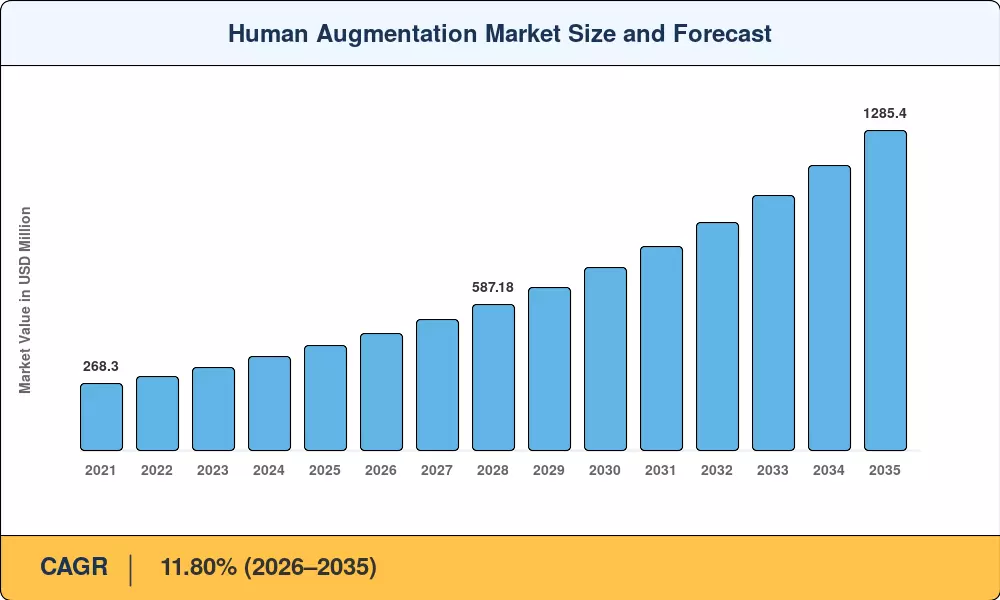
Organizations across healthcare, industrial manufacturing, defense, and consumer sectors are increasingly investing in augmentation technologies to improve human performance and address physical limitations. The convergence of artificial intelligence, robotics, nanotechnology, and biomedical engineering is further accelerating innovation in this space, creating new opportunities for market expansion. As digital transformation continues across industries, human augmentation technologies are becoming essential tools for improving operational efficiency, safety, and human-machine collaboration. Human Augmentation Market reached an estimated USD 420.18 billion in 2025 and is projected to grow from USD 469.76 billion in 2026 to USD 1,285.40 billion by 2035, registering a CAGR of 11.80% across the forecast period (2026–2035).
Leading Industry Participants
The Human Augmentation Market is highly competitive, with major technology companies, healthcare organizations, robotics manufacturers, and biotechnology firms actively developing innovative augmentation solutions. These companies focus on research and development, strategic collaborations, and product innovation to strengthen their market presence and address evolving consumer and industrial requirements.
Leading Industry Participants:
• IBM Corporation
• Microsoft Corporation
• Google LLC
• Samsung Electronics Co., Ltd.
• Apple Inc.
• Garmin Ltd.
• Ekso Bionics Holdings Inc.
• ReWalk Robotics Ltd.
• Cyberdyne Inc.
• B-Temia Inc.
• Panasonic Holdings Corporation
• Sony Group Corporation
• Medtronic plc
• Abbott Laboratories
• BrainCo Inc.
These companies are investing heavily in wearable technologies, neural interfaces, robotic exoskeletons, and AI-powered augmentation systems to expand their product portfolios and maintain a competitive edge in the rapidly evolving market.
Download Research Sample with Industry Insights –
https://www.marketresearchfuture.com/sample_request/5043
Key Growth Factors
Several factors are contributing to the rapid expansion of the Human Augmentation Market. One of the primary growth drivers is the increasing demand for advanced healthcare solutions aimed at improving patient outcomes and quality of life. Wearable health monitoring devices, robotic prosthetics, and neurostimulation technologies are helping individuals manage chronic conditions, recover from injuries, and enhance mobility. Rising healthcare expenditures and growing awareness of assistive technologies are further supporting market growth.
Another important factor is the increasing adoption of augmentation technologies in industrial environments. Companies are implementing wearable devices and robotic exoskeletons to improve worker productivity, reduce fatigue, and minimize workplace injuries. The defense sector is also investing significantly in human augmentation technologies to enhance soldier performance, situational awareness, endurance, and mission effectiveness. Additionally, advancements in artificial intelligence, machine learning, and sensor technologies are enabling more sophisticated augmentation systems that can seamlessly integrate with human capabilities.
Emerging Growth Opportunities
The Human Augmentation Market offers substantial opportunities for innovation and expansion across multiple industries. Brain-computer interfaces represent one of the most promising growth areas, enabling direct communication between the human brain and external devices. These technologies have the potential to revolutionize healthcare, communication, and assistive applications for individuals with neurological disorders or physical disabilities.
The growing adoption of augmented reality and mixed reality technologies is creating new opportunities in education, training, healthcare, and industrial maintenance. These solutions provide immersive experiences that enhance learning, operational efficiency, and decision-making. Furthermore, the emergence of AI-driven cognitive augmentation tools is enabling professionals to improve productivity, data analysis, and problem-solving capabilities. Smart implants, bioelectronic medicine, and next-generation prosthetics are also expected to generate significant growth opportunities as technological advancements continue to improve functionality, safety, and affordability.
Key Market Barriers & Challenges
Despite its strong growth potential, the Human Augmentation Market faces several challenges that could hinder widespread adoption. One of the primary barriers is the high cost associated with advanced augmentation technologies, particularly robotic exoskeletons, neural implants, and sophisticated wearable systems. These costs can limit accessibility for many consumers and organizations, especially in developing economies.
Ethical concerns surrounding human enhancement and data privacy also present significant challenges. As augmentation technologies become more integrated with the human body and cognitive processes, issues related to personal privacy, cybersecurity, and informed consent become increasingly important. Regulatory complexities and stringent approval requirements for medical devices and implants can slow product commercialization. Additionally, concerns regarding long-term safety, reliability, and social acceptance may impact adoption rates across certain user groups and industries.
Segment-wise Market Breakdown
The Human Augmentation Market is segmented based on technology, functionality, component, application, and end-user industry. Each segment addresses specific augmentation requirements ranging from healthcare rehabilitation to industrial productivity enhancement.
Market Segmentation:
By Technology
• Wearable Devices
• Exoskeleton Systems
• Brain-Computer Interfaces
• Augmented Reality Solutions
• Virtual Reality Systems
• Smart Implants
By Functionality
• Physical Augmentation
• Cognitive Augmentation
• Sensory Augmentation
By Component
• Hardware
• Software
• Services
By Application
• Healthcare and Rehabilitation
• Industrial Operations
• Military and Defense
• Consumer Electronics
• Education and Training
• Sports and Fitness
By End User
• Hospitals and Healthcare Facilities
• Manufacturing Enterprises
• Defense Organizations
• Research Institutions
• Individual Consumers
Among these segments, wearable devices and healthcare applications account for a significant share due to their widespread adoption in health monitoring, rehabilitation, and personal wellness management.
Browse In-depth Market Research Report –
https://www.marketresearchfuture.com/reports/human-augmentation-market-5043
Geographical Market Insights
North America currently dominates the Human Augmentation Market due to its strong technological infrastructure, substantial healthcare spending, and significant investments in research and development. The United States remains a major contributor, supported by the presence of leading technology firms, healthcare innovators, and defense contractors actively developing advanced augmentation solutions.
Europe represents another key regional market, driven by increasing adoption of healthcare technologies, supportive government initiatives, and growing investments in industrial automation. Countries such as Germany, the United Kingdom, and France are leading innovation in wearable technologies and rehabilitation solutions. Meanwhile, the Asia-Pacific region is expected to witness the fastest growth during the forecast period.
Rapid industrialization, expanding healthcare infrastructure, rising disposable incomes, and growing investments in emerging technologies are driving market expansion in countries such as China, Japan, South Korea, and India. Latin America and the Middle East & Africa are also demonstrating increasing adoption of augmentation technologies, supported by improving healthcare systems and growing awareness of advanced assistive solutions.
➤ FAQs
1. What is human augmentation?
Human augmentation refers to the use of technology to enhance physical, cognitive, or sensory abilities beyond natural human capabilities through devices, implants, wearables, and software solutions.
2. What is driving the growth of the Human Augmentation Market?
Key drivers include advancements in healthcare technologies, increasing adoption of wearable devices, growing industrial automation, defense modernization programs, and AI integration.
3. Which technologies are commonly used in human augmentation?
Common technologies include wearable devices, robotic exoskeletons, brain-computer interfaces, augmented reality systems, smart implants, and AI-powered assistive solutions.
4. Which industry uses human augmentation the most?
Healthcare currently represents one of the largest application areas due to the widespread use of rehabilitation devices, prosthetics, health monitoring systems, and assistive technologies
.
5. What are the major challenges facing the Human Augmentation Market?
High implementation costs, ethical concerns, data privacy issues, cybersecurity risks, and regulatory requirements are among the key challenges affecting market growth.
6. Which region leads the Human Augmentation Market?
North America currently leads the market due to strong technological innovation, significant healthcare investments, and extensive research and development activities.
7. What is the projected growth rate of the Human Augmentation Market?
The Human Augmentation Market is projected to grow at a CAGR of 11.80% between 2026 and 2035, reaching approximately USD 1,285.40 billion by the end of the forecast period.
➤➤ Market Research Future Coverage Across Regions:
Crime Risk Report Market-
https://www.marketresearchfuture.com/reports/crime-risk-report-market-28411
Convergent Billing Market-
https://www.marketresearchfuture.com/reports/convergent-billing-market-29054
User Activity Monitoring Market-
https://www.marketresearchfuture.com/reports/user-activity-monitoring-market-32621
Dynamic Random Access Memory Market-
https://www.marketresearchfuture.com/reports/dynamic-random-access-memory-market-38141
Intrusion Detection System Market-
https://www.marketresearchfuture.com/reports/intrusion-detection-system-market-1553
Multi Cloud Management Market-
https://www.marketresearchfuture.com/reports/multi-cloud-management-market-1670
Enterprise Asset Management Market-
https://www.marketresearchfuture.com/reports/enterprise-asset-management-market-1783
Data Colocation Market-
https://www.marketresearchfuture.com/reports/data-colocation-market-2023
Mobile Wallet Market-
https://www.marketresearchfuture.com/reports/mobile-wallet-market-2059
Telecom Api Market-
https://www.marketresearchfuture.com/reports/telecom-api-market-2349
Sagar Kadam
Market Research Future
+ +1 628-258-0071
email us here
Visit us on social media:
LinkedIn
Facebook
YouTube
X
Legal Disclaimer:
EIN Presswire provides this news content "as is" without warranty of any kind. We do not accept any responsibility or liability for the accuracy, content, images, videos, licenses, completeness, legality, or reliability of the information contained in this article. If you have any complaints or copyright issues related to this article, kindly contact the author above.
