

Robot End-Effector Market In 2029
Robot End-Effector Market Report
Robot End-Effector Market Report
Robot End-Effector Market Size
The Business Research Company’s Robot End-Effector Global Market Report 2026 – Market Size, Trends, And Forecast 2026-2035
LONDON, GREATER LONDON, UNITED KINGDOM, January 7, 2026 /EINPresswire.com/ -- Robot End-Effector Market to Surpass $10 billion in 2029. Within the broader Machinery industry, which is expected to be $5,141 billion by 2029, the robot end-effector market is estimated to account for nearly 0.2% of the total market value.
Which Will Be the Biggest Region in the Robot End-Effector Market in 2029
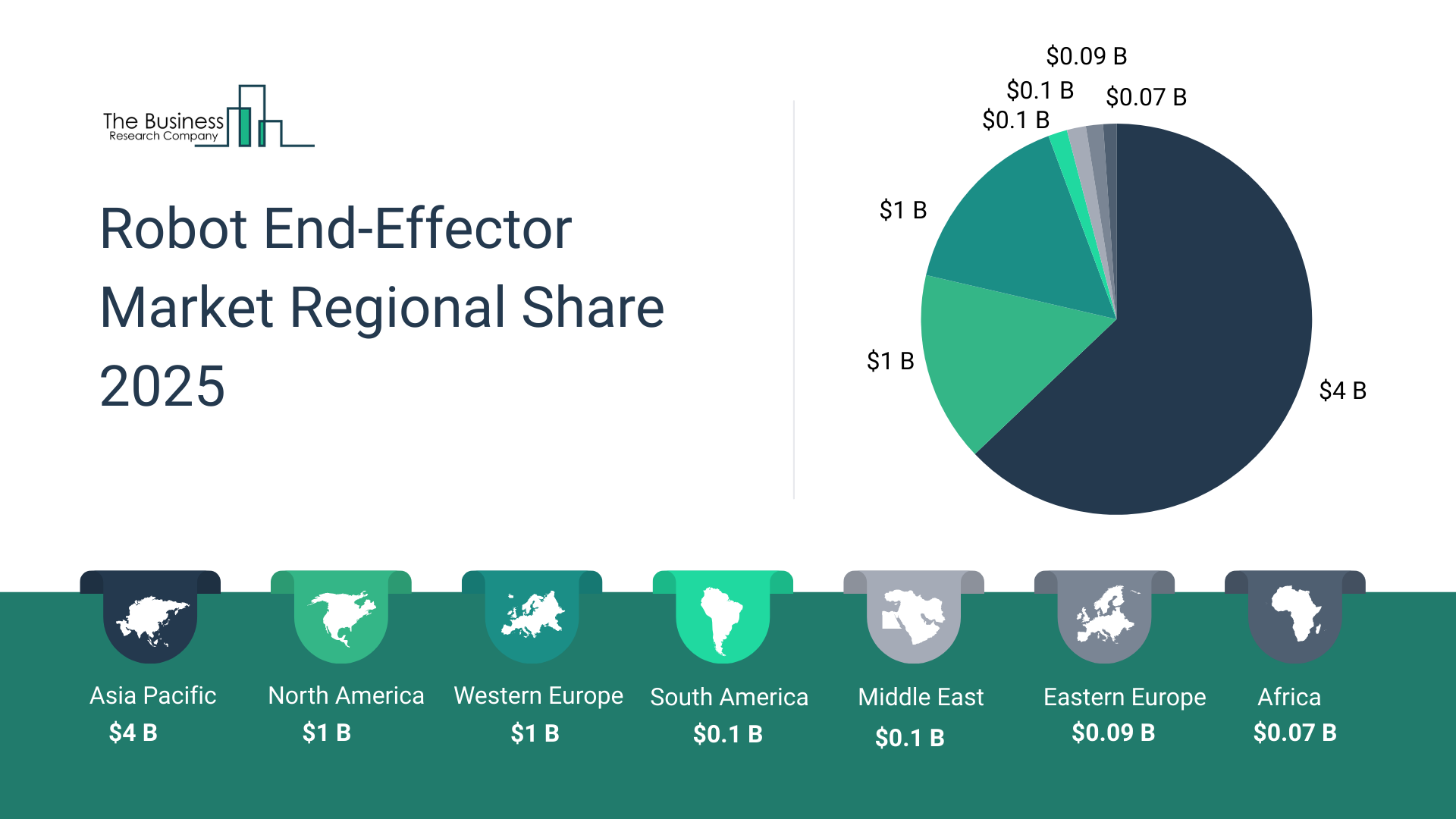
Asia Pacific will be the largest region in the robot end-effector market in 2029, valued at $6,548 million. The market is expected to grow from $3,397 million in 2024 at a compound annual growth rate (CAGR) of 14%. The rapid growth is supported by the increasing focus on lean manufacturing practices and rising e-commerce and logistics.
Which Will Be The Largest Country In The Global Robot End-Effector Market In 2029?
China will be the largest country in the robot end-effector market in 2029, valued at $4,165 million. The market is expected to grow from $2,196 million in 2024 at a compound annual growth rate (CAGR) of 14%. The rapid growth can be attributed to the increasing focus on lean manufacturing practices and rising e-commerce and logistics sectors.
Request a free sample of the Robot End-Effector Market report
https://www.thebusinessresearchcompany.com/sample_request?id=8861&type=smp
What will be Largest Segment in the Robot End-Effector Market in 2029?
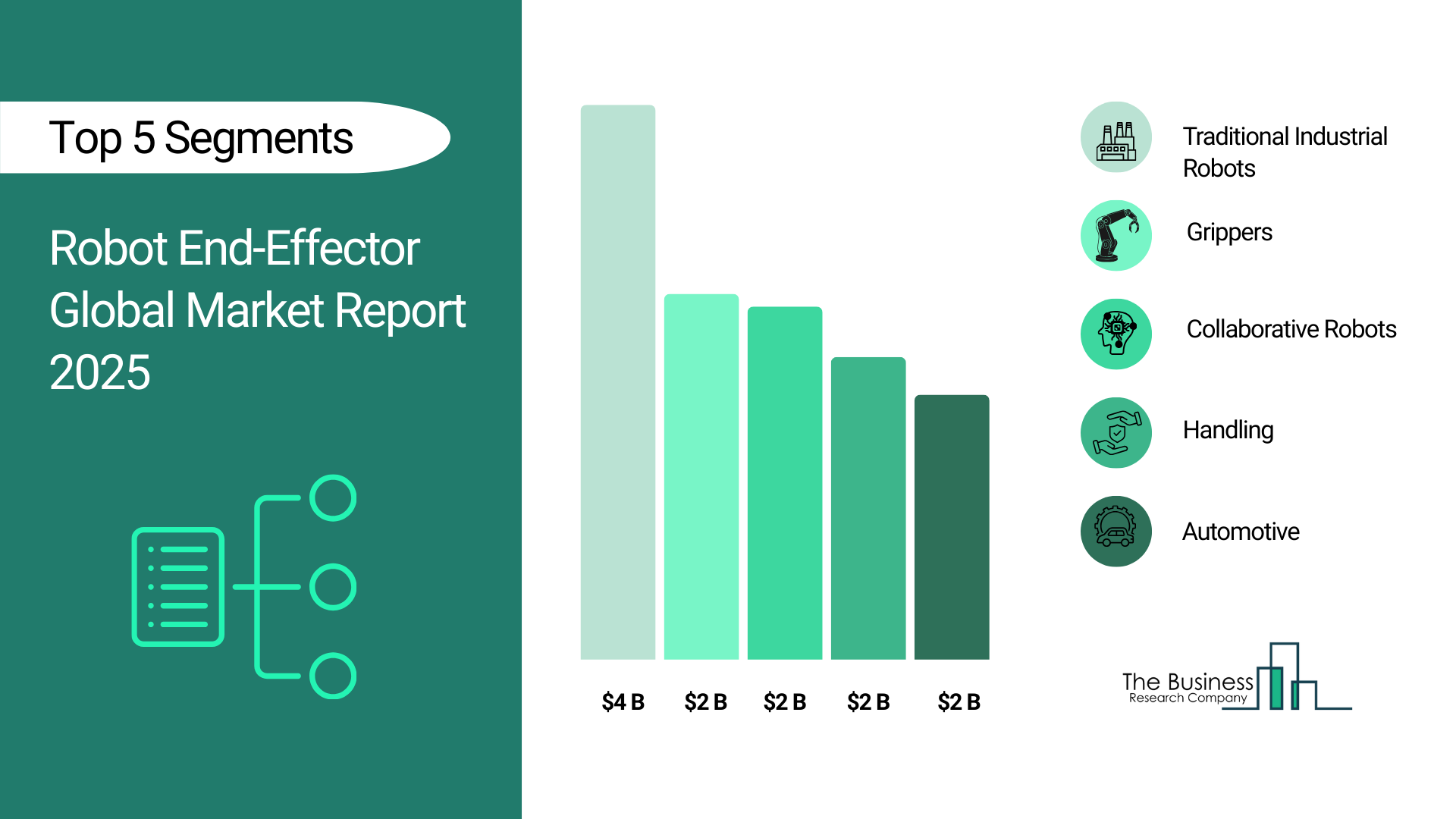
The robot end-effector market is segmented by type into grippers, welding guns, clamps, suction cups, tool changers and other types. The grippers market will be the largest segment of the robot end-effector market segmented by type, accounting for 33% or $3,263 million of the total in 2029. The grippers market will be supported by increasing demand for precise and flexible material handling in manufacturing lines, rising adoption in e-commerce and logistics for automated picking and placing, growth in packaging and palletizing activities across industries, advancements in adaptive and soft grippers for handling delicate objects, increasing need for high-speed and high-accuracy operations in food and pharmaceutical sectors, growing implementation in collaborative robots for safe human-robot interaction and expanding applications in electronics assembly requiring delicate component handling.
The robot end-effector market is segmented by robot type into traditional industrial robots and collaborative robots. The traditional industrial robots market will be the largest segment of the robot end-effector market segmented by robot type, accounting for 56% or $5,616 million of the total in 2029. The traditional industrial robots market will be supported by widespread use in large-scale manufacturing industries, increasing replacement of human labor in hazardous environments, growth in automotive and metal fabrication sectors, higher payload capacities and precision offered by traditional robots, long-term cost efficiency through reduced operational errors, integration with Industry 4.0 technologies and rising focus on enhancing productivity through fully automated lines.
The robot end-effector market is segmented by application into handling, welding, assembly, processing, dispensing and other applications. The handling market will be the largest segment of the robot end-effector market segmented by application, accounting for 38% or $3,847 million of the total in 2029. The handling market will be supported by increasing automation in logistics, warehousing and production lines, growing demand for material transfer and pick-and-place operations, advancements in adaptive gripping solutions for irregular shapes, rising use in food and pharmaceutical industries for hygiene-sensitive handling, growing e-commerce sector driving robotic packaging and fulfillment needs, deployment in semiconductor manufacturing for precise part handling and need for speed and reliability in high-throughput environments.
The robot end-effector market is segmented by industry into automotive, electrical and electronics, metals and machinery, food and beverages and other industries. The electrical and electronics market will be the largest segment of the robot end-effector market segmented by industry, accounting for 32% or $3,205 million of the total in 2029. The electrical and electronics market will be supported by miniaturization of components requiring precise assembly and handling, increasing automation in PCB production and testing, growth in semiconductor fabrication requiring contamination-free processes, rising global demand for consumer electronics, use of soft and adaptive grippers for delicate materials, integration of vacuum-based and electromagnetic end-effectors and expansion of electronics manufacturing hubs in Asia-Pacific.
What is the expected CAGR for the Robot End-Effector Market leading up to 2029?
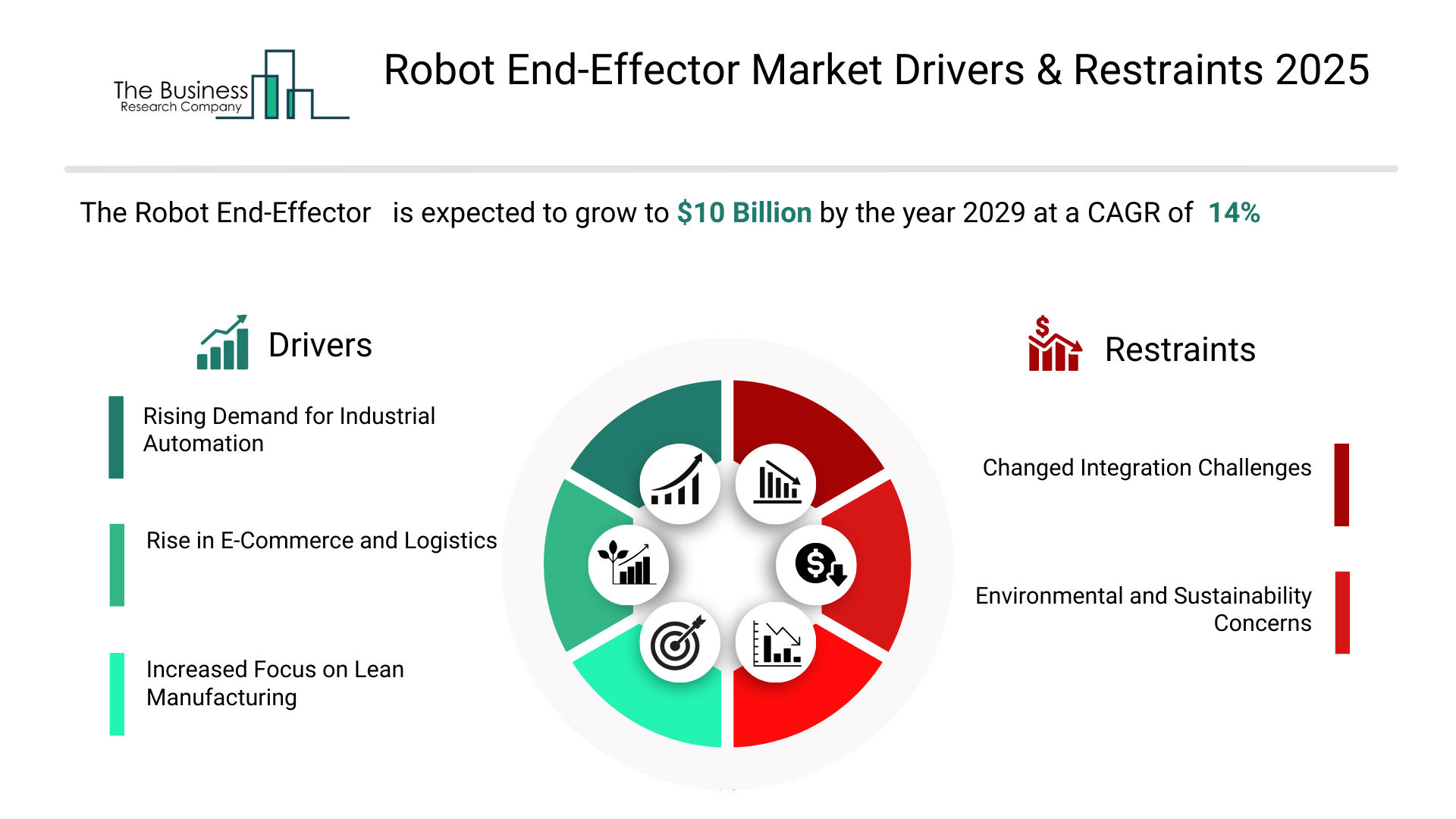
The expected CAGR for the robot end-effector market leading up to 2029 is 14%.
What Will Be The Growth Driving Factors In The Global Robot End-Effector Market In The Forecast Period?
The rapid growth of the global robot end-effector market leading up to 2029 will be driven by the following key factors that are expected to reshape industrial quality assurance and manufacturing processes worldwide.
Rising Demand For Industrial Automation - The rising demand for industrial automation will become a key driver of growth in the robot end-effector market by 2029. Industrial automation relies heavily on robots equipped with end-effectors to perform a variety of tasks such as material handling, assembly, welding and packaging with precision and efficiency. As sectors like automotive, electronics, food and beverage and logistics adopt automation to meet increasing consumer expectations and address labor shortages, the need for versatile, high-performance end-effectors continues to grow. These tools enable robots to adapt to different tasks, product types and environments, making them essential to flexible manufacturing systems. Furthermore, the integration of AI and smart sensors into end-effectors is expanding their capabilities, allowing for real-time decision-making and advanced object recognition, further fueling their demand in automated industrial setups. As a result, the rising demand for industrial automation is anticipated to contributing to a 1% annual growth in the market.
Rise In E-Commerce And Logistics - The rise in e-commerce and logistics will emerge as a major factor driving the expansion of the robot end-effector market by 2029. With the exponential growth of online shopping, especially post-pandemic, companies are under immense pressure to process, pick, pack and ship goods rapidly and accurately. Robot end-effectors—such as adaptive grippers, suction cups and smart picking tools, are essential for automating these repetitive tasks, enabling robots to handle a wide variety of items with different shapes, sizes and fragility. These tools improve productivity, reduce errors and operate efficiently even in 24/7 environments. Additionally, the push for same-day or next-day delivery has intensified the need for robotic solutions in last-mile and warehouse operations, making robot end-effectors a critical component of modern logistics and driving strong market growth in this sector. Consequently, the rise in e-commerce and logistics is projected to contributing to a 0.8% annual growth in the market.
Increased Focus On Lean Manufacturing Practices - The increased focus on lean manufacturing practices will serve as a key growth catalyst for the robot end-effector market by 2029, lean manufacturing emphasizes minimizing non-value-added activities, optimizing resource utilization and maintaining consistent product quality, all goals that robotic systems with advanced end-effectors are well-suited to achieve. Robot end-effectors, such as precise grippers, welding tools and automated assembly attachments, enable high-speed, repeatable operations with minimal errors and downtime. They support just-in-time production by allowing quick reconfiguration and handling of varied tasks, which is essential for manufacturers operating in high-mix, low-volume environments. As companies increasingly adopt lean strategies to stay competitive and respond to fluctuating market demands, the integration of robot end-effectors becomes a key enabler of streamlined, efficient and scalable manufacturing processes, thereby accelerating market growth. Therefore, this increased focus on lean manufacturing practices is projected to supporting to a 0.8% annual growth in the market.
Increasing Focus On Workplace Safety - The increasing focus on workplace safety will become a significant driver contributing to the growth of the robot end-effector market by 2029. In industries such as automotive, manufacturing, chemical processing and logistics, tasks involving heavy lifting, sharp tools, extreme temperatures, or repetitive motion pose significant risks to workers. Robot end-effectors, such as grippers, welding torches and cutting tools enable robots to safely perform these high-risk operations with precision and consistency, thereby minimizing workplace injuries and improving compliance with occupational safety regulations. Additionally, the rise of collaborative robots (cobots) equipped with safety-certified end-effectors allows for safe human-robot interaction on shared workspaces, making automation accessible even in small-scale operations. As companies prioritize employee well-being and regulatory compliance, the demand for robotic end-effectors that enhance safety while maintaining productivity is expected to grow steadily, driving market expansion. Consequently, the increasing focus on workplace safety is projected to contributing to a 0.3% annual growth in the market.
Access the detailed Robot End-Effector Market report here:
https://www.thebusinessresearchcompany.com/report/robot-end-effector-global-market-report
What Are The Key Growth Opportunities In The Robot End-Effector Market in 2029?
The most significant growth opportunities are anticipated in the grippers robot end-effector market, the collaborative robot end-effector market, the handling robot end-effector market, and the robot end-effector for electrical and electronics market. Collectively, these segments are projected to contribute over $8 billion in market value by 2029, driven by advances in automation, increasing adoption of collaborative and flexible robotic systems, and expanding applications across automotive, logistics, electronics, and industrial manufacturing sectors. This surge reflects the accelerating deployment of versatile and sensor-equipped end-effectors that enable high-precision, efficient, and safe robotic operations, fueling transformative growth within the broader robot end-effector industry.
The grippers robot end-effector market is projected to grow by $1,706 million, the collaborative robot end-effector market by $2,591 million, handling robot end-effector market by $2,011 million, and the robot end-effector for electrical and electronics market by $1,819 million over the next five years from 2024 to 2029
The Business Research Company (www.thebusinessresearchcompany.com) is a leading market intelligence firm renowned for its expertise in company, market, and consumer research. We have published over 17,500 reports across 27 industries and 60+ geographies. Our research is powered by 1,500,000 datasets, extensive secondary research, and exclusive insights from interviews with industry leaders.
We provide continuous and custom research services, offering a range of specialized packages tailored to your needs, including Market Entry Research Package, Competitor Tracking Package, Supplier & Distributor Package and much more
Disclaimer: Please note that the findings, conclusions and recommendations that TBRC Business Research Pvt Ltd delivers are based on information gathered in good faith from both primary and secondary sources, whose accuracy we are not always in a position to guarantee. As such TBRC Business Research Pvt Ltd can accept no liability whatever for actions taken based on any information that may subsequently prove to be incorrect. Analysis and findings included in TBRC reports and presentations are our estimates, opinions and are not intended as statements of fact or investment guidance.
The Business Research Company
Americas +1 310-496-7795
Europe +44 7882 955267
Asia & Others +44 7882 955267 & +91 8897263534
Email: info@tbrc.info
Oliver Guirdham
The Business Research Company
+44 7882 955267
info@tbrc.info
Visit us on social media:
LinkedIn
Facebook
X
Legal Disclaimer:
EIN Presswire provides this news content "as is" without warranty of any kind. We do not accept any responsibility or liability for the accuracy, content, images, videos, licenses, completeness, legality, or reliability of the information contained in this article. If you have any complaints or copyright issues related to this article, kindly contact the author above.
